
Are you worried about toxic chemicals leaking into your food products? Bad packaging can ruin your brand and harm your customers. You need to know the right safety standards.
When buying paper tube packaging, you must check FDA rules for the US or EC 1935/2004 for the EU. Ensure the paper, ink, glue, and inner lining have migration test reports. The packaging must not change the food’s taste, smell, or safety.
Finding the right packaging is hard. I have seen many buyers struggle with this. They face long lead times and hidden fees. They also find it hard to verify if a supplier is truly eco-friendly. Let me share what I know from running IWYNNERPACKAGING. We will look at the exact rules you need to follow to keep your food safe and your brand strong.
| Die Type | Material | Complexity | Cost | Best For |
|---|---|---|---|---|
| Single-Level | Brass/Magnesium | Low | $ | Simple logos, text |
| Multi-Level | Brass | Medium | $$ | Designs with varied depth |
| Hand-Tooled | Steel/Copper | High | $$$$ | Highly detailed, sculptural art |
What are the 5 essential requirements for packaging?
Do your current paper tubes fail to protect your food? Weak packaging leads to stale food and angry buyers. You must meet five basic rules to succeed.
The five essential requirements for food packaging are protection, containment, communication, utility, and safety. Your paper tubes must keep food safe from moisture, show clear labels, be easy to use, hold the product well, and use non-toxic materials.
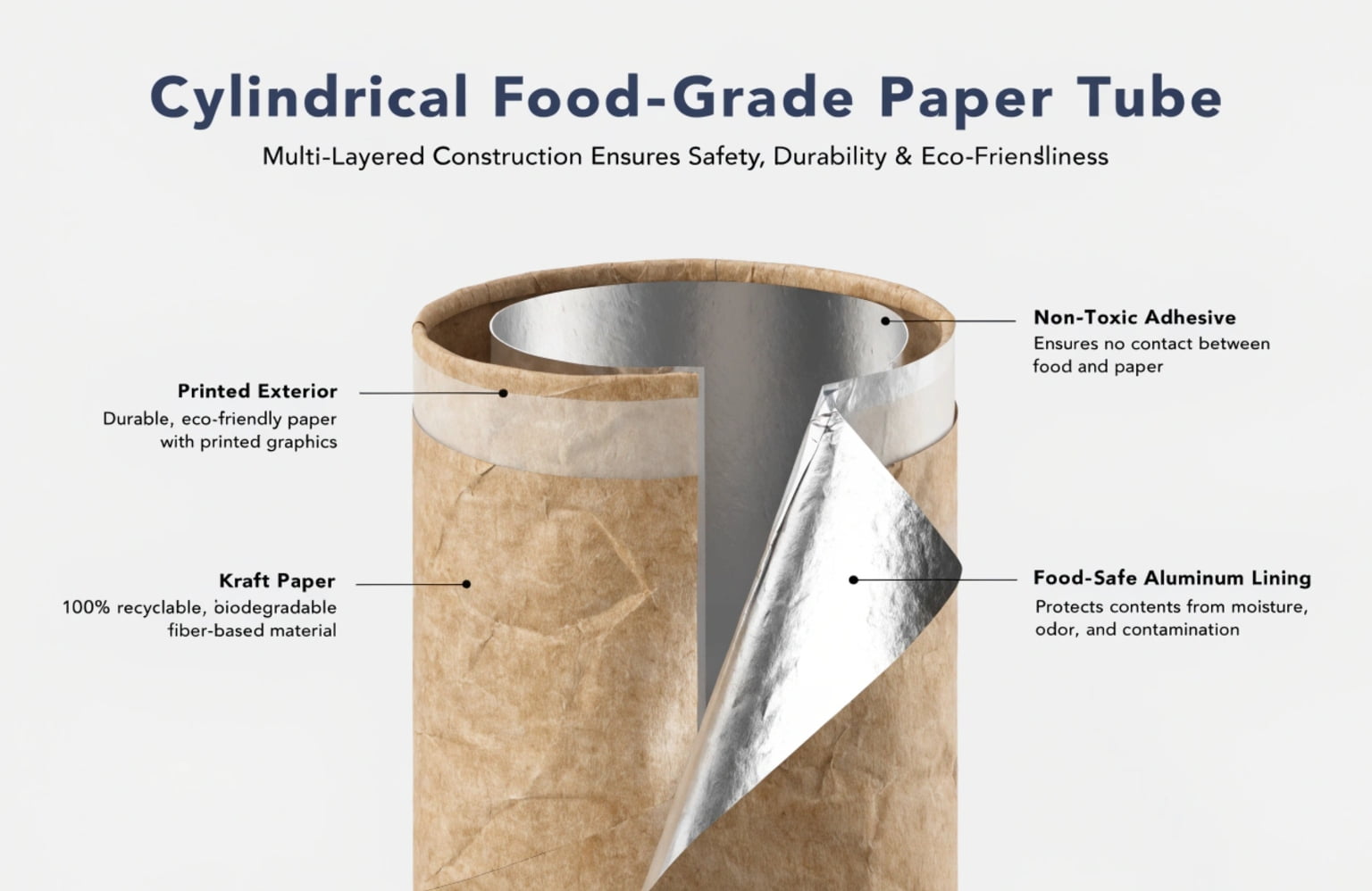
Breaking Down the 5 Rules
When I first started working with custom paper tubes, a client from the United States came to me. Her previous supplier used cheap glue. The glue smelled bad and ruined her organic tea. This taught me a big lesson. You cannot just focus on how the tube looks. You must look at the whole picture.
Here is how we break down the five rules at our factory:
| Requirement | What It Means for Paper Tubes | Why It Matters |
|---|---|---|
| Protection | Blocking moisture, oxygen, and light. | Keeps food fresh and extends shelf life. |
| Containment | Holding the food without leaking. | Stops waste and mess during shipping. |
| Communication | Printing clear labels and brand info. | Tells buyers what is inside and builds trust. |
| Utility | Easy to open, close, and store. | Makes the customer happy to use it. |
| Safety | Using FDA-approved materials. | Prevents health risks and legal trouble. |
Why Safety is the Most Important
Safety is the core of everything. If your packaging is not safe, the other four rules do not matter. You need to ask your supplier for proof. At IWYNNERPACKAGING, we always show our clients the test reports. We use food-grade kraft paper and safe linings. We use aluminum foil or PE film inside the tubes. This stops oil and water from ruining the paper.
Many large company buyers want beautiful designs. But aesthetics must come with safety. We make sure the ink on the outside does not bleed into the inside. We make sure the glue holds the tube together without adding bad smells. If you need custom paper tubes that meet all five rules, you can always reach out to us. We make sure your packaging works perfectly and looks great.
What is the difference between food grade packaging and food safe packaging?
Are you confused by supplier claims? Many buyers think "food grade" and "food safe" mean the same thing. This mistake can cause big legal problems for your brand.
Food grade means the material itself is safe for human use and has no toxic chemicals. Food safe means the final packaging is safe for your specific food under your specific storage conditions. A material can be food grade but not food safe.
The Real Meaning of Food Safe
Let me share a story. A few years ago, a buyer wanted paper tubes for hot cocoa powder. She bought "food grade" tubes from another factory. But the inner lining melted slightly when stored in a hot warehouse. The material was food grade, but it was not "food safe" for high heat.
My core insight is this: Do not just ask "is it food grade?" You must ask if it fits your specific food and target market rules. You must ask if the whole set of materials has complete compliance proof.
How to Check the Difference
You need to look at the whole package. This includes the paper, the ink, the glue, and the coating.
| Feature | Food Grade | Food Safe |
|---|---|---|
| Definition | The raw material is safe. | The final product is safe for your food. |
| Focus | Chemical makeup of the material. | How the material acts with your food. |
| Example | FDA-approved kraft paper. | A paper tube that does not leak oil from your snacks. |
| Proof Needed | Material safety data sheet. | Migration test reports for the whole tube. |
Getting the Right Proof
You must ask your supplier for a full compliance statement. If you sell in the US, you need FDA proof. Any packaging that touches food directly must follow FDA rules. If you sell in Europe, you need EC 1935/2004 proof. The proof must show that no bad chemicals will move into your food.
We always provide these documents to our clients. We test our paper tubes to make sure they do not change the smell or taste of your food. We want you to feel safe when you buy wholesale paper tubes from us. We know that clear communication about design and safety is very important to you.
What are the quality standards for food packaging by portion?
Do you struggle to pack different sizes of food? Wrong portion packaging leads to food waste and lost money. You need to match the standard to the size.
Quality standards for food packaging by portion focus on weight limits, volume accuracy, and barrier strength. Small single-serve tubes need high moisture barriers. Large bulk tubes need strong structural support to prevent crushing. Both must pass strict migration tests.
Matching Size to Strength
I remember working with a brand owner who sold premium matcha powder. She wanted small, single-serve paper tubes and large, bulk paper tubes. She thought she could use the exact same paper thickness for both. I had to explain that bulk tubes need much thicker walls. If the wall is too thin, the large tube will crush during shipping.
Standards for Different Portions
Different sizes need different rules. Here is a simple guide we use at our factory:
| Portion Size | Key Quality Standard | Best Material Choice |
|---|---|---|
| Single-Serve (under 50g) | High moisture barrier, easy to open. | Thin kraft paper with aluminum foil lining. |
| Medium (50g – 250g) | Good balance of strength and barrier. | Standard paper tube with PE film. |
| Bulk (over 250g) | High crush resistance, strong glue. | Thick cardboard core with food-safe wax coating. |
Why the Lining Matters
No matter the portion size, the inside of the tube must be safe. For dry snacks or powders, you need a strong barrier against oxygen and water. If the barrier fails, the food goes bad. We always test our paper tubes to make sure they hold the right amount of food safely.
We check the glue and the ink too. We make sure they do not contain lead or BPA. We also check the bottom seal of the tube. A large portion needs a very strong bottom seal so the food does not fall out. We use advanced machines to roll the edges tightly. If you need help choosing the right size for your custom paper tubes, our team is ready to help. We offer timely delivery and consistent quality for every order.
What are the minimum requirements for food grade materials?
Are hidden toxins sneaking into your packaging? Cheap materials often hide dangerous chemicals. You must know the absolute minimum rules to keep your customers safe.
The minimum requirements for food grade materials are zero toxicity, no odor, and no taste transfer. The materials must not contain heavy metals, BPA, or phthalates. They must pass migration tests to prove chemicals do not move into the food.
The Danger of Cheap Materials
A client once showed me a sample she got from a very cheap supplier. The paper tube looked nice on the outside. But when I smelled the inside, it had a strong chemical odor. The supplier used industrial glue instead of food-safe glue. This is a huge risk. The minimum requirement is that the packaging must not change the smell or taste of the food.
The Core Rules You Must Follow
You cannot compromise on these basic rules. Here is what you must check:
| Material Part | Minimum Requirement | What to Avoid |
|---|---|---|
| Paper / Cardboard | Must be virgin or certified food-safe recycled. | Unknown recycled paper with ink residue. |
| Inner Lining | Must block oil and water safely (like PE or Foil). | Coatings that melt or peel off easily. |
| Glue / Adhesive | Must be non-toxic and odorless. | Industrial glues with strong chemical smells. |
| Printing Ink | Must be heavy-metal free and food-safe. | Inks containing lead or phthalates. |
Asking for the Right Documents
You must ask your supplier for a Declaration of Compliance. This document proves the whole tube is safe. It should list the FDA rules or EU rules it passes. The materials must be tested to ensure ingredients do not migrate into the food at high levels.
At IWYNNERPACKAGING, we only use safe, tested materials. We know that large company buyers need reliable suppliers. We never hide fees, and we always show our eco-certifications. We use eco-friendly materials that meet strict safety rules. We want to make your sourcing process easy and safe. We help you avoid the pain of long lead times and bad quality.
What are the ISO standards for food packaging?
Does your supplier have a messy factory? Poor factory conditions lead to dirty packaging. You need to look for ISO standards to ensure clean production.
The main ISO standard for food packaging is ISO 22000. This standard focuses on food safety management systems. It ensures the factory uses Good Manufacturing Practices (GMP) to prevent cross-contamination. FSSC 22000 is another strict standard for packaging safety.
Why Factory Standards Matter
I have visited many factories in my life. Some look clean, but they do not have strict rules. Workers might touch the inside of the paper tubes with dirty hands. Bugs or dust might get into the boxes. This is why ISO standards are so important. They force the factory to follow strict steps.
At our factory, we follow Good Manufacturing Practices (GMP). We make sure our production lines are clean and safe. Our workers wear hairnets and gloves. We keep our factory free from pests and dust.
Key ISO Standards to Know
When you talk to a supplier, ask about these standards:
| Standard Name | What It Covers | Why You Need It |
|---|---|---|
| ISO 9001 | Quality management system. | Ensures consistent product quality and timely delivery. |
| ISO 22000 | Food safety management. | Stops contamination during the making of the tubes. |
| FSSC 22000 | Advanced food safety for packaging. | Meets the highest global rules for food contact. |
| GMP | Good Manufacturing Practices. | Keeps the factory floor clean and workers trained. |
Building Trust with Certifications
If a supplier has these certifications, it means they care about safety. It means they have a system to catch mistakes before the tubes ship to you. We know that buyers value clear communication and reliable quality. We work hard to keep our factory up to these high standards.
When you buy custom paper tubes from us, you get peace of mind. You know the packaging is made in a clean, safe place. We have 3 production lines and 80 employees working hard for you. We export to the United States, Australia, the United Kingdom, and Canada. We know the standards of developed countries very well.
FAQs
Q1: Do I need FDA approval for paper tubes?
A1: Yes, if you sell in the US. The inner lining, glue, and paper that touch the food must meet FDA food contact rules. Always ask your supplier for an FDA compliance statement.
Q2: Can paper tubes hold oily foods?
A2: Yes, but they need a special food-grade lining. We use materials like aluminum foil or PE film inside the tube. This stops the oil from leaking into the paper.
Q3: How do I know if the ink is safe?
A3: You must ask for a test report. The ink used on the outside of the tube must not contain heavy metals like lead. It must not migrate through the paper into the food.
Q4: What is a migration test?
A4: A migration test checks if chemicals from the packaging move into the food. It is a strict lab test. You need this report to prove your packaging is truly food safe.
Q5: Does recycled paper meet food grade standards?
A5: Usually, no. Standard recycled paper can have old ink and chemicals. For direct food contact, you must use virgin paper or specially certified food-safe recycled paper.
Conclusion
Buying food-grade paper tubes requires checking FDA or EU rules, testing materials, and verifying factory standards. Always ask for full compliance documents to keep your food and brand safe.
